
The Ultimate Guide to Choosing an AI SAST Analysis Tool
Why an AI Powered SAST Platform Is Now Essential for Modern Development Teams
The best AI powered SAST platform options in 2025/2026 include:
- High-Speed Scanners – Ultra-fast scans (10-second median CI time), strong noise filtering, and large rule communities
- Intelligent Data-Flow Engines – Millions of data-flow cases, 80% autofix accuracy, and real-time IDE feedback
- Enterprise-Grade Solutions – 35+ languages, 80+ frameworks, and agentic IDE guidance
- Compliance-Focused Platforms – Enterprise-grade compliance and broad language coverage
- Rapid Analysis Tools – Scans millions of lines in minutes with significant false positive reduction
- Noise-Reduction Specialists – Up to 95% false positive reduction and sandbox-validated AI fixes
Shipping code fast is no longer optional. Neither is shipping it securely.
AI is changing how developers write code — and it’s changing how security teams need to scan it. AI code generation tools produce large volumes of code quickly. Traditional SAST tools were built for slower cycles, human-written code, and smaller codebases. They weren’t designed for this reality.
The result? Alert fatigue. Walls of findings. Low developer trust. Real vulnerabilities buried under thousands of false positives.
This is exactly where an AI powered SAST platform changes the game.
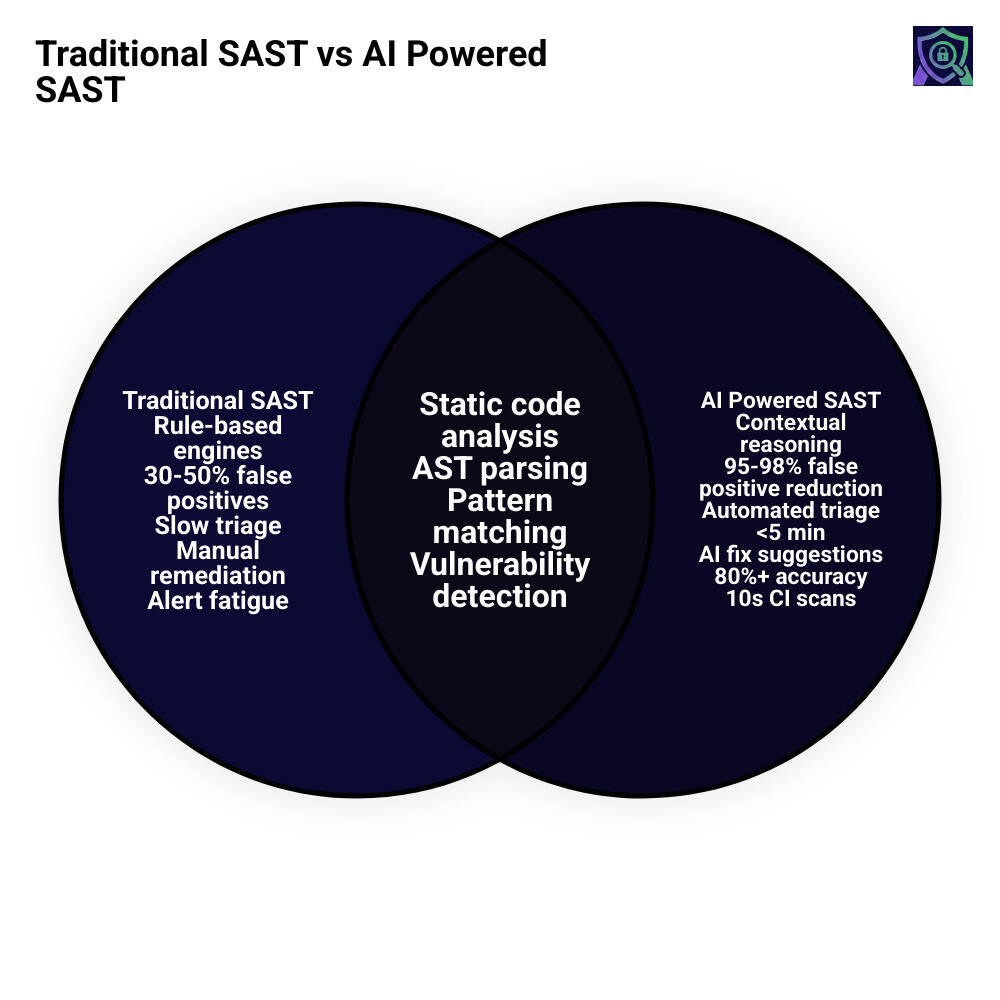
Instead of just flagging pattern matches, modern AI SAST tools understand context. They reason about data flows, filter noise automatically, and suggest fixes that developers can actually use. Some tools reduce false positives by up to 95-98% compared to traditional rule-based engines.
But not all tools are equal. Some just layer AI on top of legacy rule engines. Others rebuild detection from the ground up using large language models. The difference matters — a lot — for your team’s productivity and your security posture.
This guide breaks down the top AI SAST platforms, what makes each one different, and how to pick the right one for your team.
Understanding the Evolution of Static Analysis
Static Application Security Testing (SAST) has been around for decades, but the “old way” is hitting a breaking point. Traditionally, SAST tools work by parsing source code into an abstract syntax tree (AST). This creates a mathematical map of your code, which a rule-based engine then scans for specific patterns.
The problem? Rule-based engines are rigid. They are excellent at finding a specific “if-this-then-that” scenario, but they struggle with nuance. If a piece of code looks dangerous but is actually protected by a custom security filter elsewhere in the app, a traditional tool will flag it anyway. This leads to the dreaded “wall of red” — hundreds of alerts that developers eventually learn to ignore.
Modern development requires a shift in how we think about code context. We are moving from simple pattern matching to deep semantic understanding. While legacy tools cause alert fatigue, an ai powered sast platform uses machine learning to “read” code more like a human security researcher would. It doesn’t just see a vulnerable function; it sees the entire data flow and understands if that vulnerability is actually reachable and exploitable in your specific environment.

Key Advantages of an AI Powered SAST Platform
The move toward shift-left security—moving testing earlier into the development process—only works if the tools don’t slow developers down. Here is how AI transforms the experience:
- Massive Noise Reduction: By using reachability analysis, AI can determine if a vulnerable piece of code is actually connected to an external input. Some platforms report reducing false positives by up to 95%.
- Triage Automation: Instead of a security pro spending hours manually checking every “High” alert, AI agents can group similar issues, eliminate duplicates, and provide plain-language explanations of why a finding matters.
- Exploitability Scoring: Not all bugs are created equal. AI looks at the real-world risk, including package popularity and exploit maturity, to help teams prioritize what to fix first.
- Enhanced Developer Experience: Instead of just saying “this is broken,” these platforms provide “Agentic Remediation”—actual code snippets that fix the bug. Modern AI engines, for instance, boast an 80% accuracy rate for their autofixes.
AI-Native vs AI-Powered SAST Platform
It is important to distinguish between “AI-powered” and “AI-native” tools.
- AI-Powered SAST: These are often established, deterministic scanners that have added an AI layer on top. The AI might help summarize findings or suggest fixes, but the “brain” finding the bugs is still a traditional rule engine.
- AI-Native SAST: These tools are often built from the ground up using Large Language Models (LLMs). They use LLM reasoning to detect complex logic flaws that rules might miss.
The best approach is often a hybrid one. You want the repeatability of symbolic AI (deterministic rules) combined with the “reasoning” capabilities of generative AI.
Maximizing ROI with an AI Powered SAST Platform
When we look at the return on investment (ROI), it isn’t just about finding more bugs; it’s about the “productivity tax.”
- Reduced Triage Time: If your team can reduce time-to-triage from hours to under 5 minutes, you’re saving thousands of engineering hours per year.
- Faster Remediation Cycles: With AI-generated fixes, the Mean Time to Remediate (MTTR) can drop by over 80%.
- Clearing Security Debt: AI can scan through massive backlogs of legacy code and prioritize the “reachable” risks, helping teams burn down years of security debt in weeks.
Critical Evaluation Criteria for Modern Security Teams
Choosing an ai powered sast platform isn’t just about the “AI” buzzword. We recommend evaluating tools based on these practical requirements:
- Language and Framework Coverage: Does it support your stack? Leading platforms lead here with 35+ languages, but smaller, newer tools might only support the “big three” (JavaScript, Python, Go).
- Integration Depth: A tool that requires a separate login is a tool that won’t be used. Look for deep integration into IDEs (like VS Code or Cursor) and CI/CD pipelines.
- Scan Speed: A 10-second median scan time is the gold standard for keeping developers in the “flow state.”
- Compliance Readiness: If you are chasing SOC2 or GDPR compliance, you need a tool that maps findings directly to these frameworks.
| Feature | AI-Augmented (Traditional + AI) | AI-Native (LLM-First) |
|---|---|---|
| Detection Method | Deterministic Rules + AI Triage | LLM Contextual Reasoning |
| Accuracy | High (for known patterns) | Very High (for logic flaws) |
| Speed | Fast to Moderate | Can vary based on LLM latency |
| Best For | Regulated Enterprises | Fast-moving SaaS/AI Startups |
Overcoming Limitations in Automated Scanning
Even with AI, automated scanning isn’t perfect. For example, detecting issues with the MD5 hash function is easy for any scanner, but understanding a complex, multi-file business logic flaw—like an Indirect Object Reference (IDOR) bug—is much harder.
Current limitations include:
- Dataflow Tracking: Some AI tools struggle with very large, “polyglot” architectures where data moves between different languages and microservices.
- False Negatives: While AI is great at reducing noise, there is always a risk it might “reason away” a real vulnerability if it doesn’t have enough context about your business logic.
- Scan Speed vs. Depth: Deep LLM reasoning takes more computing power than a simple regex scan. Finding the balance between a 10-second PR check and a deep weekly scan is key.
Selecting the Right AI Powered SAST Platform
When you’re ready to pick a platform, look for “Agentic Remediation.” This is the future. Instead of a static report, you want a tool that can act like a junior security engineer—scanning every push, validating a fix in a sandbox, and then opening a Pull Request for you.
For organizations that want to avoid the “pipeline tax,” look for “pipelineless” scanning. These tools connect directly to your GitHub or GitLab instance and scan code in the background without requiring you to mess with YAML files or CI configurations.
Frequently Asked Questions about AI SAST
How does AI reduce false positives in static analysis?
AI reduces noise by performing “reachability analysis.” It checks if a vulnerable piece of code can actually be reached by an untrusted user input. If the code is “dead” or properly sanitized by a different part of the app, the AI can automatically dismiss the alert.
Can AI SAST tools detect complex business logic flaws?
Yes, this is one of the biggest upgrades over traditional SAST. Because AI-native tools can “read” and reason about the intent of the code, they are much better at finding flaws like broken authentication or authorization (IDORs) that don’t follow a simple “bad pattern.”
What is the difference between AI-native and AI-powered tools?
AI-powered tools add AI features (like fix suggestions) to a traditional rule-based scanner. AI-native tools use LLMs as the primary engine for finding the vulnerabilities themselves.
Conclusion
The era of choosing between “fast” and “secure” is over. By adopting an ai powered sast platform, your team can keep up with the speed of AI-assisted development without drowning in security debt.
At Aman, we believe security should be accessible and lightning-fast. Our platform provides automated penetration testing and comprehensive SAST analysis that fits right into your existing workflow. We offer a blazing-fast, free platform that gives you instant AI explanations and fix suggestions, integrated with over 50 security scanners to ensure nothing slips through the cracks.
Ready to see how modern AI can transform your security? Check out our full suite of security tools and start scanning for free today.
Secure Your Apps with Aman
Put these mitigation steps into practice. Get professional-grade vulnerability detection in one place.
Launch Your First Scan Now